Mensagens

A mostrar mensagens com a etiqueta BPM

Do you control process scenarios costs?

Usually people that participates in process design, know that it comes a time to propose process changes to someone in the company. Process team meets and prepares a presentation which summarizes the problems, solutions proposed, benefits, return on investment, etc.. This is a collaborative process that in some companies is presented to the C level for discussion and formal approval of TO-BE process. In general we know that such presentations indirectly evaluate people's work, so there is a special preparation for this purpose. In these situations some weak process teams tends to increase the detail and execute an endless revision process of the presentation content, thus document drafting becomes high inefficiency process, which is contrary to the spirit of the challenge. Last week I returned to go through a situation that has not happened to me for some time. The team took two days to prepare a presentation of 6 pages summarizing improvement opportunities of a purchasing ...

Buying train tickets. A process improvement opportunity

Imagem
Some years ago CP has introduced an innovation in customer services through the provision of electronic tickets. The sale of train tickets still proceeds in a similar way to bus tickets purchase. People usually arrive at the station around the time of departure, buy a ticket and board. The trains running between Oporto and Lisbon (the two main Portuguese cities) do not always have tickets availability when train departs, which require in the past purchasing the ticket at the station in advance, causing inconvenience. Before this service was introduced, it was possible to buy tickets at ATMs, however there were some operational restrictions between systems integration that were causing disturbances in operation. With the adoption of electronic tickets, the flow of passengers at stations decreases and therefore can reduce staff. The process of issuing an electronic ticket is simple, intuitive and fast. On the other hand, when there are strikes or maintenance work on railway line...

Skepticism about the ontology construction

I understand the point some people argue that on the different views, we individuals, can structure on different abstractions: organizations, processes and their relationships, thus this can leads that my ontology is better, or worst or different from yours leading to different conceptions of business reality. To prevent this from happening it's necessary to implement a dynamic ontologies management that interacts with enterprise systems where the knowledge resides - artefacts (entities if you want) used or produced by an enterprise, now these artefacts related to business processes must be managed automatically. Indeed ontologies management cannot be a static, like a photograph that was taken to represent the company context at a given time, on the contrary, must be dynamically updated as storage of new process models, update, retrieval or deletion of existing process models where all the entities connect. If you think that when structuring business processes you need to ide...

Semantic Business Process Management – Part one

Imagem
This is the mirror post in Redux online but with Portuguese translation. 1. Introduction:   The interest to write this series of articles was triggered last year when Google failed to introduce one of it's social products: The Google Wave . When it was released in mid- 2009, was considered a threat to Facebook, because it had enhanced features like attach files, and other content. I thought that more than a threat it could be a tool able to be used in the business world for collaboration in business process orchestration. Curiously few months after Google announcement (in October 2009) SAP introduced a prototype where showed the integration of Google Wave in a product called Gravity   . Later, in February of 2010 that prototype evolved for a product called Streamwork . Other companies followed the same steps with other approach: IBM released IBM Blue Works     ; ARIS already had released the ARIS ALIGN   and others followed. Gartner introduced the ...

The BPMS contradiction

Case Management are the first breach in BPM systems. It can lead several systems for manage the business processes. Want structured? Infinitely repeatable? Buy BPMS. Want AD-HOC process capability? Buy other tool. This is the ultimate contradiction since BPMS arose in the market. Most case management marketing managers are telling the wrong story, because actually you can build a case management process in a standard BPMS. For example: just add infinite loops in each process state before moving to the next one capable of interacting and catching information with colleges, partners, external stakeholders, whatever. Make possible to go forward and backward in every state. Simply remember petri nets rules and you can do it. It's pure mathematics. The thing is it can take more time do it in a standard BPMS rather in a case management tool.

Activity analysis check list

In my previous post I expanded the concept of activity dimension analysis. This post is a little detour on my next couple of posts which will only look to ontology management applied to BPM. Nevertheless considered important taking into account new types of processes such as case management or AD-HOC process. The Activities are structured tasks that produce a result for a determined entity. The activities are next-to-last level of process representation (the last level is task level that composes activities). Without its comprehension we do not understand how business processes work. For process knowledge and understanding, structure it, implement it, control it and improvement it, is critic to perform an activities analysis using the dimensions indicated bellow. Another important aspect is that the analysis approach used. It should be through a combination of process walkthrough, information coming from managers and participants and with static analysis using a process map. ...

Activity analysis

Imagem
How long you don't look to activities in accordance with this perspective? Have you thought about the gaps lately? Where are your improvement opportunities? Your BPMS system allows this kind of analysis, or is just a repository of useless data stored in a database? Have you ever thought in Semantic BPM ? Something that can understand natural language and convert to what you are looking for somewhere lost in a database table using ontology management ? Did you know that most of the process improvement opportunities can't be identified using process maps? If anyone is trying to convince otherwise is telling you a very big lie! Wakeup More to come soon...

Case Management the Race is On

In this article posted by Keith Swenson is argued that BPM is one thing, Case Management is other thing, because: What drives BPM is:" is defined as a way of defining a process, and maintaining it over time.", and, Case management is driven by: "useful for collaborative, dynamic, and information-intensive processes which requires incremental and progressive responses from the case handler to determine actions". I say this may lead people to wrong concepts. I think the issue here is not the definition: what is BPM what CM is. I consider it’s important to define things, otherwise business people, process people will misinterpret the idea and at the end hurt is done. The issue here is that BPM continues to be and it will be the philosophy to manage business processes. Some are structured with more or less flowcharts and documents (some structured processes don’t need documents and charts at all regarding people qualification to perform the tasks!) a...

BEDL - Data 4 BPM do we need it?

Imagem
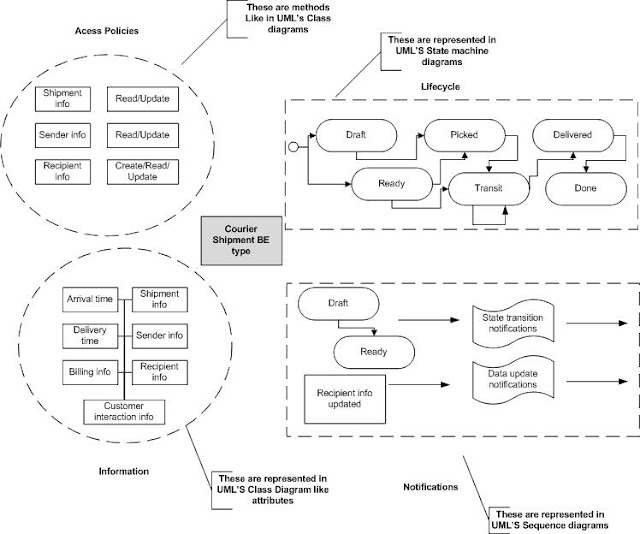
This a mirror of my first post in Redux online. IBM recently launched the proposal for a new business processes notation called BEDL - Business Entity Definition Language. To access IBM’S documents follow this link: http://www.ibm.com/developerworks/websphere/library/techarticles/1004_nandi/1004_nandi.html According to the team that developed the concept: “in most suites of tools for managing business process, data is treated mostly as an afterthought. The activities and their flows are the main abstractions and the data handled by the processes are essentially the hidden variables. The presentation and aggregation of data are treated outside the process definition and implemented through generic service calls. This unique approach of the process ignores the important data perspective during the analysis of business operation”. When I started reading the article I’ve got caught by the idea of developing a standard that would help implement business processes in BPMS, represen...

AntiAmba in Redux Style

Imagem
This is just to let you know that from today, I became a guest blogger in Redux online. Redux is a leading BPM blog that encourages people to share ideas among the BPM community. I’m very proud of sharing my contributions inside Redux. If you’re interested check AntiAmba Redux link . Thank you Theo for the invitation.

BPMN can bring death to your process data

Imagem
Some days ago I took a ride in IBM's Lombardi Blueprint another on-line tool that let's you discover, design and document business processes and share process knowledge among your team and peers. Very aligned what today is called collaborative process management or social BPM. In this article I don't analyse Lombardi's tool regardless I liked the way data is structured, clear, specially for non bpm experts that need to participate in process mapping and analysis, allow simple documentation (yet sufficient) with some automation provided, there is also risk analysis - very basic, probably useless. Anyway, the core feature is the capability to introduce on-line collaboration that runs smoothly. The thing is the suite have a built in feature that can import Visio process diagrams designed using BPMN notation, meaning that you don't have to construct process diagrams all over again. Lombardi announce, or suggests, users to get rid of Visio and start using Blueprint...

Let we forget

Some interesting debate about Process Modeling : Doing by Design, from Gartner's Jim Sinur. My thoughts about it: I don't agree with Keith when he says that "BPM is synonymous with BPMN graphical notation". Many people continue not to understand what BPMN is all about. Geeks say it's mandatory to execute BPEL in order to authoring BPM processes inside a BPMS suite, but as I far my experience goes I never saw any BPM suite doing it magically without a lot of hard code work. On the other hand, I see BPMN as a door to process oblivion, once people start using it incorrectly, I mean with all the stuff,and complex symbols attached (please don't read 2.0 draft, because it is more and more complex). By the way, I tested IBM's Lombardy that can't import true BPMN diagrams. This means that BPMN never become a standard at all. When designing something new, I prefer to use storyboards. I assemble a team with process facilitators, process team and end user...

Enterprise Architectures

Imagem
Enterprise Architectures at it's best (or worst). I like this image very much. Source: http://blogs.msdn.com/mikewalker/archive/2009/03/11/mapping-current-state-architectures-across-the-enterprise.aspx

Concept Maps

Imagem
This year I rediscovered concept maps. I remember using it 10 years ago when I started working on BPM projects. I don't know why but I stop using it, maybe because BPMS promised a lot of tools to architect  Business Processes. Figured out that some key points are always missed if you start diagramming immediately processes.   This map was created using a simple free tool from called CMapTools  http://cmap.ihmc.us

BPM definitions need clarification fast

I always hated meaningless definitions, specially if they bring confusion to people mind, are used by business consultants implement no results project. Today BPM is facing the lack of a strong and revised definition. Today there is new (old) BPM reality: Adaptive Process . Gartner calls it ad-hoc processes, Forrester calls it dynamic case management. A lot of definitions are popping up among the community. Today I revisited OMG's process definition included in BPMN 2.0 draft. Take a deep breath. This is only an extract: Private business process - internal use (?!) Private business process can be: executable or non-executable (?!) Public processes - represents the interactions between a private Business Process and another Process A Choreography is a type of process, but differs in purpose and behaviour from a standard BPMN Process. A standard Process, or an Orchestration Process. (?!) I remember some time ago BPM Nexus where trying to produce and accord document to ...

Some more toughts about Adaptive Business Processes

5 years ago a leading BPM vendor I worked with promised the possibility to break the barrier of accessing information - they called it artifacts, assessed trough pc/mobile/phone/ whatever people real need to work with. Today this barrier still exist. This end-user expectation it's about the capability to connect immediately to data/forms/things if a user wants to, specially when these artifacts aren't available - that makes people mad, slow down task execution, people "invent" excel files, increase cycle time, error, etc. Accessing information in real time when you real need it, manipulated by the end user directly , if no data connection is available is the holly grail of IT. If you have some real world examples, please, leave a comment. This requirement is related to adaptive process definition by Max J. Pucher . I would like this requirement to be a reality, but unfortunately isn't and it seems to me it's an utopia. It's necessary that the BPM comm...

Colaborize

Like this tool to bring social engagement to your company. From Democrasoft .

Trends in Business Process Management - Adaptive processes

Gartner uses a crystal ball to introduce a set of trends that companies and software vendors should look for. Some of them are often vapourware. Anyway one of the latest trends is a pattern based strategies. Some of the links available are these: Spotting Patterns on the Fly: A Conversation with Birders David Sibley and Julia Yoshida How Will BPM Deal with Pattern Based Strategies (PBS)? Jim Sinur Performance-driven culture key for pattern-based strategy - IT online Some useful concept usage can be found bellow: The Predictive Accounting Revolution And where it all began: Strategy Theory Initiative" (STI) The other one is the adaptive processes: The agenda - Michael Hammer 's last  book When Should a Process Be Art, Not Science? - Joseph M. Hall and M. Eric Johnson Some very interesting points about the subject here: Gartner Group predicts Adaptive Process Trend - Max J. Pucher Adaptive BPM…No Mapping tools… - Andrew One degree Managing unstructur...

Business Process Management - Gas Station Case study

Imagem
In the past 3 years we have seen in Portugal exponential growth of retail business at gas stations. Although the concept is not new, it started 20 years ago in A1 highway, SONAE together with  GALP were responsible for the growth of this business concept. Some stores even have become small coffee shops, where customers stop to drink coffee and read the newspaper headlines. The main problem is the difficulty in serving customers, especially at peak times, mainly early morning, when people stop to fill up the car and some drink an espresso and buy a newspaper. There are not enough people to meet payment requests and to serve coffee, and sometimes all the people available are serving coffee and no one is receiving the payments, or vice versa. In order to be served inside the store you need to pay everything simultaneously. You cannot pay fuel first and coffee latter (is this a process constraint?). Business impact. First, fuel sales decrease (a huge loss) once cycle time is ...

Airport BPM Project

Imagem
This is a news report of a BPM project I personally managed 3 years ago. It consists of airport infrastructure inspection automation in real time to all Portuguese airports. Thank Ana Airports for this opportunity. I'm not the guy parking the aircraft. I'm the guy it make it happen. Sorry but there is not English translation available. If you want information about it, leave a comment. Click on the images to read the text in full scale.